AI Filmmaking for Agencies: Should You Build In-House or Use a Unified Platform?
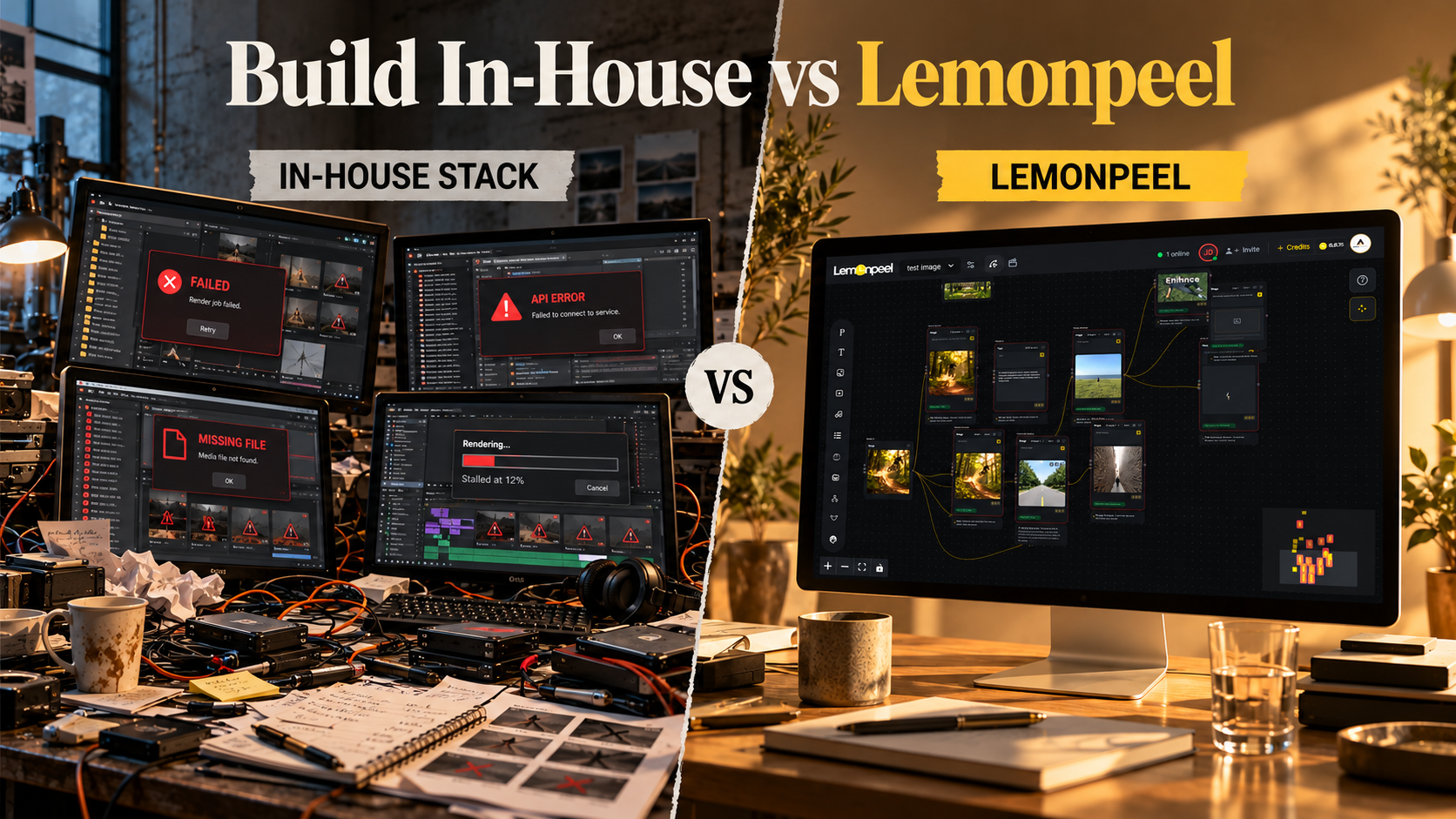
Sooner or later, every agency that experiments with AI video reaches the same decision. The early tests worked, clients are interested, and now someone has to decide how this will run day to day. Do you build your own setup from separate models, scripts and tools, or do you adopt one platform that covers most of the pipeline?
There is no universal answer. The right choice depends on your team, your client mix and how much operational work you’re willing to own. This article walks through both options honestly, including where each one costs more than people expect.
What “building in-house” actually means
Building in-house rarely means writing a video model from scratch. For most agencies it means assembling a stack: pick a few video and image models, add a voice tool, add an editor, connect them with scripts or automation, and write internal guidelines for how everyone uses them.
Done well, this gives you real advantages. You choose every component, you can swap one out the moment a better model appears, and you can tailor the process to how your agency already works. If you have a technical producer or a developer who enjoys this kind of work, the setup can fit your team like a glove.
It also keeps data and process fully under your control, which some clients with strict requirements will appreciate.
The hidden costs of the DIY route
The part people underestimate is maintenance. Models change, interfaces update, pricing shifts and APIs break. Someone has to notice, fix it and tell everyone else. If that someone is a busy producer who built the setup on weekends, it becomes a single point of failure.
Then there is onboarding. A new hire needs to learn five tools, where files live and which prompts or settings the team prefers. That knowledge usually sits in a few people’s heads, and it takes weeks to pass on.
Consistency is another cost. When characters, products and brand assets are stored in different places, it takes discipline to keep everyone using the same approved versions. Discipline is fine when the team is three people. It gets harder at fifteen.
Finally, the billing is scattered. Several subscriptions and credit pools make it difficult to see what a single project cost, which matters when you’re quoting the next one.
None of this makes in-house a bad idea. It means the real price isn’t the subscriptions; it’s the time spent keeping the system running.
What a unified platform offers
A unified platform takes the opposite approach. Instead of assembling parts, you work in one environment that includes multiple models, asset storage, editing tools and team features. Setup is short, onboarding is easier and cost tracking is simpler.
When you evaluate ai filmmaking software for agencies in this category, these are the things worth checking:
● Model range. Does it offer more than one video model, so you can pick per shot?
● Consistency tools. Can it keep a character or product the same across a whole sequence?
● Shared assets and brand controls. Are references, logos and colours stored once and reused?
● Team features. Are there roles, permissions and credit limits?
● Reusable workflows. Can repeated steps be saved as templates?
● Delivery. Does it handle other aspect ratios, subtitles and translations?
● Integration. If you do have developers, can the platform connect to your other systems?
The trade-off is flexibility. You work within what the platform supports, and if it lacks a feature you need, you wait or work around it. You are also dependent on the provider’s decisions about pricing and roadmap.
Comparing the two on what matters
Rather than listing pros and cons in the abstract, it helps to compare them on the questions agencies actually ask.
Speed to start. A platform wins by a wide margin. You can run a real project in days. A custom stack can take weeks before it is stable.
Ongoing effort. A platform shifts the maintenance to the provider. In-house puts it on your team, and it grows with every tool you add.
Quality ceiling. In-house can win here if you have specialists who know how to tune each model. A platform may limit fine-grained settings, though many now offer a lot of control.
Consistency across a team. Platforms with shared libraries make this easier. In-house depends on your own conventions.
Cost predictability. A single plan is easier to forecast than a collection of subscriptions and usage fees.
Flexibility. In-house wins if your needs are unusual. A platform wins if your needs are typical and you value time over customisation.
A middle path that many teams end up with
In practice, many agencies don’t choose one extreme. They start on a unified platform to get moving, then add custom pieces where they have a specific need. A platform with an API or automation hooks lets a technical team connect it to their project management tools or asset systems without rebuilding everything.
That hybrid approach protects you against both problems: you aren’t stuck maintaining an entire stack, and you aren’t locked into a closed box.
One example of a unified platform
LemonPeel is one platform built on the unified model. It brings text, image, video and sound onto a single canvas and gives access to models including Seedance, Kling and Wan. Its features line up with the checklist above: Character Consistency, an Asset Reference System, Brand Kit, Team Controls for members and credits, and Flows for chaining steps once and reusing them. For delivery, it offers Reframe & Resize, Translate & Lipsync and Subtitles for over 100 languages. For teams with developers, a Flow API and MCP & CLI support connect its workflows to other systems, and a Lemonpeel Agent, currently in beta, is designed to take a brief and return a cut.
Whether it suits your agency depends on your pipeline, so test it on a finished project and compare the effort required.
How to decide for your own agency
A few questions can settle most of the debate.
Do you have someone who can own the stack? If nobody has the time or the skills, a platform is safer.
How many people will use it? The more team members involved, the more shared structure matters.
How unusual are your needs? If clients require specific tools or data handling, in-house may be necessary.
How fast do you need to move? If a pitch is due in two weeks, building from scratch is risky.
What happens if the key person leaves? If the answer is “we’re stuck,” your setup is too fragile.
Run a short pilot of each approach on one real project, and measure hours spent, revisions needed and how easily a colleague could repeat the work. Numbers from your own team are more reliable than any general advice.
The bottom line
Building in-house gives you control and costs you time. A unified platform gives you time and costs you some flexibility. Most agencies find the platform route faster to start with, and the in-house route easier to justify once their volume and technical skills grow. Whatever you choose, judge your ai filmmaking software by how well it holds up when more people and more clients arrive, not just by how good the first clip looks.
FAQs
Is it cheaper to build an AI filmmaking setup in-house?
Subscriptions may look cheaper, but maintenance, onboarding and the time spent managing several tools add real cost. A unified platform usually has a higher visible price and a lower hidden one.
When does building in-house make sense for an agency?
When you have technical staff who can maintain it, unusual client requirements, or a high enough volume that custom tuning pays off. Smaller teams often do better starting on a platform.
Can an agency use a unified platform and still customise its workflow?
Often, yes. Platforms that offer reusable workflows, an API or command-line tools let technical teams connect them to their own systems without building everything from scratch.